The Employee Offboarding Checklist: Every Step and Who Owns It


When someone leaves a company, the work of the departure is split across at least four people:
- The manager handles the handover of in-flight work
- HR runs the paperwork and the exit interview
- IT pulls access and collects equipment
- and finance closes out payroll.
Nobody owns the whole process, and most of the people involved only deal with a departure a few times a year.
This post covers what a complete checklist needs to include and a practical way to run it so each step actually gets done by its deadline.
Knowledge transfer and handing over in-flight work
Begin with an inventory: open projects, client or vendor relationships they own, and recurring duties like a weekly report or a monthly invoice run. For each item on the inventory, name a successor and have the departing employee write down enough for that person to take over:
- current status
- where the files live
- who the contacts are
- any deadlines already promised.
For complex workflows, a recorded screen walkthrough captures more than a document.
If the person owns customer relationships, treat each account as its own handover with an introduction to the new owner. The structure is the same as any planned ownership change between teams: check out this guide to running a sales-to-customer-success handoff in Slack.
Revoking access across your SaaS tools
A mid-sized company typically runs on dozens of SaaS products, and a departing employee has accounts in many of them. If you use single sign-on, deactivating the SSO account covers the connected tools in one step. Where SSO doesn't apply, tools have to be found and revoked one by one, which is why the access step belongs on a checklist.
The risk of skipping this is well documented. A Beyond Identity survey of over 1,100 employees and business leaders found that 83% of respondents could still access accounts from a previous employer after leaving, and only 9% remembered IT being involved in their offboarding at all!
A practical approach: keep a per-person access inventory while people are employed (your SSO admin panel plus expense reports will surface most of it) and revoke on a defined schedule.
Equipment, final pay, and benefits
Equipment return is easy to overlook, especially for remote employees. List what the person has (laptop, monitor, badge, keys, hardware tokens), and for remote staff, send a prepaid shipping box before the last day rather than after it.
Final pay has legal deadlines, and they vary by jurisdiction. In the US there's no federal deadline — the Department of Labor notes that state law controls, and many states set different deadlines depending on whether the person quit or was let go, in some cases requiring payment on the last day itself.
The exit interview
The exit interview is HR's step. ADP's offboarding guidance recommends having someone other than the direct manager conduct it and giving the employee a few days' notice so they can collect their thoughts.
Keep the questions open-ended, write down what you hear, and route anything actionable to whoever can act on it. The interview is only worth the half hour if the notes actually go somewhere afterwards.
Announcements
- The departing person's own team should hear the news first, directly from the manager
- For a voluntary departure, agree on the wording with the employee
- Notify the people who interact with the person from outside: clients, vendors, and partner teams
Miscellaneous
Then there's the quieter category of things:
Remove from the on-call rotation and any approval chains where they're the approver.
Transfer ownership of documents and shared folders; in Google Workspace, files owned by a deleted account can become inaccessible to everyone else, so transfer before deactivating.
Reassign recurring meetings they organize, set up email forwarding, take them off distribution lists, and reassign their accounts in the CRM.
Each of these is a small task, but a skipped one surfaces weeks later as a dead calendar invite or a document nobody can edit.
Voluntary departure vs. termination
Most of the checklist is the same in both cases, but the timing and the order of the steps change.
With a voluntary departure and a notice period, you have two weeks or more for the handover, and access normally stays on until the end of the final shift so the person can keep working. The checklist runs front-loaded: knowledge transfer and successor training fill the notice period, and the access and equipment steps cluster on the last day.
With a termination, access is cut at or immediately before the notification, and equipment is collected the same day or by courier. Knowledge transfer compresses to whatever can be reconstructed from documents and the team's memory, which is a good argument for keeping handover documentation current before anyone is leaving.
One sequencing detail matters in both cases: transfer ownership of documents and accounts before deactivating, because deactivation can orphan content in ways that are tedious to undo.
A sample employee offboarding checklist
Here's a concrete employee offboarding checklist for a voluntary departure with two weeks' notice, grouped by timeline. Owners in this example: Priya is the manager, Dave is in HR, Maya is in IT, and Sam runs payroll. Adjust the names and the split to your own org; the point is that every step has exactly one owner.
| When | Step | Owner |
|---|---|---|
| Last two weeks | Inventory open projects, client accounts, and recurring duties; name a successor for each | Priya (manager) |
| Last two weeks | Handover docs written and walked through with each successor | Priya (manager) |
| Last two weeks | Pull the access inventory: SSO apps, non-SSO tools, shared logins, API keys | Maya (IT) |
| Last two weeks | Schedule the exit interview and send questions in advance | Dave (HR) |
| Last two weeks | Confirm final pay deadline, vacation payout, and benefits end date | Sam (payroll) |
| Last two weeks | Announce the departure: team first, then clients and partner teams with new contacts | Priya (manager) |
| Last day | Collect laptop, badge, keys, and hardware tokens (or confirm the return shipment) | Maya (IT) |
| Last day | Transfer document and folder ownership, reassign recurring meetings | Maya (IT) |
| Last day | Revoke Google Workspace and SSO access at end of shift, terminate active sessions | Maya (IT) |
| Last day | Rotate shared passwords the person knew; set up email forwarding | Maya (IT) |
| Last day | Hold the exit interview and file the notes | Dave (HR) |
| Last day | Remove from on-call rotation and approval chains | Priya (manager) |
| After departure | Final payroll processed, expenses reimbursed, benefits paperwork sent | Sam (payroll) |
| After departure | Audit for residual access: non-SSO tools, API keys, OAuth grants, vendor accounts | Maya (IT) |
| After departure | Update org chart, distribution lists, and the CRM | Dave (HR) |
| After departure | Deactivate Slack account | Maya (IT) |
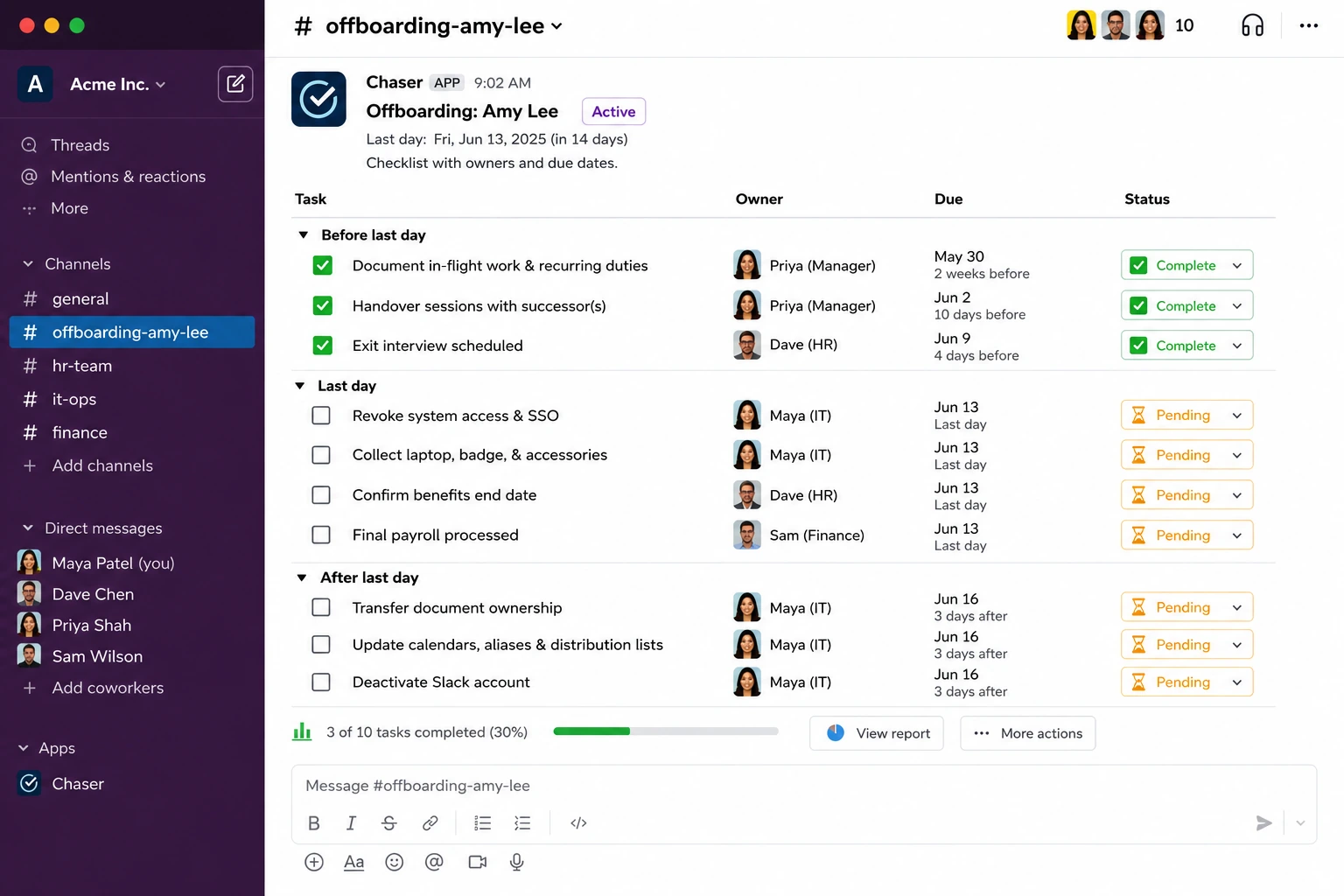
There are a few places that checklist can live, and the main difference between them is follow-up. An HR platform with offboarding workflows works well if you already have one, though IT and the manager may not live in it. A shared doc or spreadsheet holds the list but reminds nobody. Slack Lists can hold it where the team already is; this guide to Slack Lists and checklists covers what they do well and where they stop.
You can also set a Slack reminder per step, but reminders are personal: nobody else can see which steps are done, and nothing follows up if a reminder is dismissed.
Chaser handles this case directly: you build the offboarding checklist once as a reusable template in Slack, with an owner and a deadline on every step, and trigger it with one command when someone hands in their notice.
Each step becomes a tracked task, so Maya gets hers and Dave gets his, and Chaser follows up with each owner automatically until their step is done, with the status of every step visible without leaving Slack. This guide to Chaser templates shows the setup. The same pattern covers any process that's cross-functional and recurring but irregular; planning a conference has the same shape.
Final thoughts
Offboarding runs well when it's treated as routine: a written checklist, one owner per step, deadlines pinned to the departure date, and a final audit after the person is gone. The manager, HR, and IT usually coordinate the departure in Slack anyway, which makes it a sensible place for the checklist to live. It also makes Slack the last account a departing employee keeps, since the coordination itself happens there, so the closing item on the list can literally be deactivating their Slack account, checked off by IT once everything above it is done.
You can try Chaser for free and see how it fits the way your team already works in Slack. Get started and add Chaser to Slack, for free.