How to Organize a Sales to Customer Success Handoff in Slack


A sales to customer success handoff is the transfer that happens after a deal closes. It's really a transfer of knowledge. The AE knows why the customer bought, what they were promised, which stakeholder pushed for the deal and which one was skeptical. If that knowledge doesn't move, the CSM starts the relationship by asking the customer questions the customer already answered during the sale.
In ABBYY's survey of 1,623 decision makers on customer onboarding, "customers repeating themselves" was cited as a top driver of churn during onboarding, alongside slow starts and poor communication. Gartner found something similar in the support context: 62% of handoffs between service channels are "high effort" for the customer, largely because the receiving side doesn't get the context the customer already provided. The handoff from sales to CS is the first transition a new customer experiences, and it sets their expectation for every one after it.
This post covers what a complete handoff includes, the process around it, why handoffs break down in practice, and a way to track the whole thing.
What a good handoff includes
The core artifact is a handoff document, that the AE fills in before the internal handoff meeting. The test for what belongs in it: anything the CSM would otherwise have to ask the customer. In practice that's six categories:
- Why they bought.
- What was promised.
- The stakeholder map.
- Success criteria, in the customer's words.
- Technical requirements and open risks.change roles.
- The artifacts. Links to call recordings, the proposal, the signed contract etc
The process around the document
The document alone doesn't transfer the relationship, so most teams wrap a short process around it. For example:
- The AE completes the handoff doc within a day or two of the deal closing, while the details are still fresh.
- An internal handoff meeting — usually 30 minutes between the AE and CSM.
- An introduction to the customer, ideally a warm one: the AE introduces the CSM by name on a call or in writing.
- The kickoff call, run by the CSM, which should demonstrate within the first five minutes that the context made the trip.
Each of those steps has an owner and a deadline, which makes the handoff a small project, one you run again and again.
Why handoffs is problematic
The failure pattern is consistent across companies. The AE's compensation and attention point at the next deal, so the handoff doc gets filled in late, thinly, or not at all. The context that exists lives in the AE's head and in CRM notes written for sales, not for the person inheriting the account.
The CSM, missing context, runs a kickoff that feels like a second discovery call. The customer, who spent six weeks explaining their situation during the sale, explains it again — and draws the obvious conclusion about how well this vendor's left hand knows its right.
The fix is making the handoff steps into actual tracked tasks with owners and dates, the same as any other recurring process.
Tracking the handoff in Slack
The structural problem with tracking a handoff in any one team's tool: the steps don't belong to one team. The AE works in the CRM. The CSM works in a CS platform, or a spreadsheet, or the same CRM configured a different way.
The one tool the entire company shares is Slack. That's what makes it a sensible medium for cross-department work generally - the work gets tracked in the place where every owner already is, rather than in the system of record of whichever team set up the process.
The CRM stays the system of record for the deal, the CS platform for the health score; the handoff checklist, which spans both teams, lives in the channel where they talk to each other anyway.
The practical setup is a channel or thread per new customer — #customer-acme, or a thread in #handoffs for smaller deals. The conversation, the handoff doc link, and the checklist sit together, and either team can see the state of the transition without asking.
Running the handoff as a checklist in Slack
Slack on its own holds the conversation but doesn't track the tasks, which is the part Chaser covers. It's a task tracker that runs inside Slack: the handoff becomes a reusable checklist you build once, with an owner and a deadline on every step, and trigger with one command each time a deal closes.
Deadlines are set relative to the close date — "handoff doc complete 2 days after close," "kickoff call held within 2 weeks" — so triggering the checklist with the real date sets every deadline at once. A {Customer} placeholder fills the new customer's name into every task. This guide to Chaser templates walks through building one.
The part that changes behavior is the follow-up. Chaser reminds each assignee as their step comes due and keeps reminding if it goes overdue, so the CSM isn't chasing the AE for the handoff doc and the CS lead isn't chasing either of them.
There's more on the general approach in this guide to task management in Slack.
A sample handoff checklist
A starting point, with Dave as the AE, Maya as the CSM, and dates relative to the close:
| Step | Owner | Due |
|---|---|---|
| Handoff doc filled in (context, promises, stakeholders, risks) | Dave (AE) | 2 days after close |
| Internal handoff call held | Maya (CSM) | 4 days after close |
| CSM reviews contract, recordings, and promised items | Maya (CSM) | 5 days after close |
| Warm intro sent to the customer | Dave (AE) | 5 days after close |
| Kickoff call with the customer held | Maya (CSM) | 2 weeks after close |
| Success plan drafted against the customer's criteria | Maya (CSM) | 3 weeks after close |
| Integration requirements handed to engineering | Maya (CSM) | 3 weeks after close |
| 30-day check-in scheduled and held | Maya (CSM) | 30 days after close |
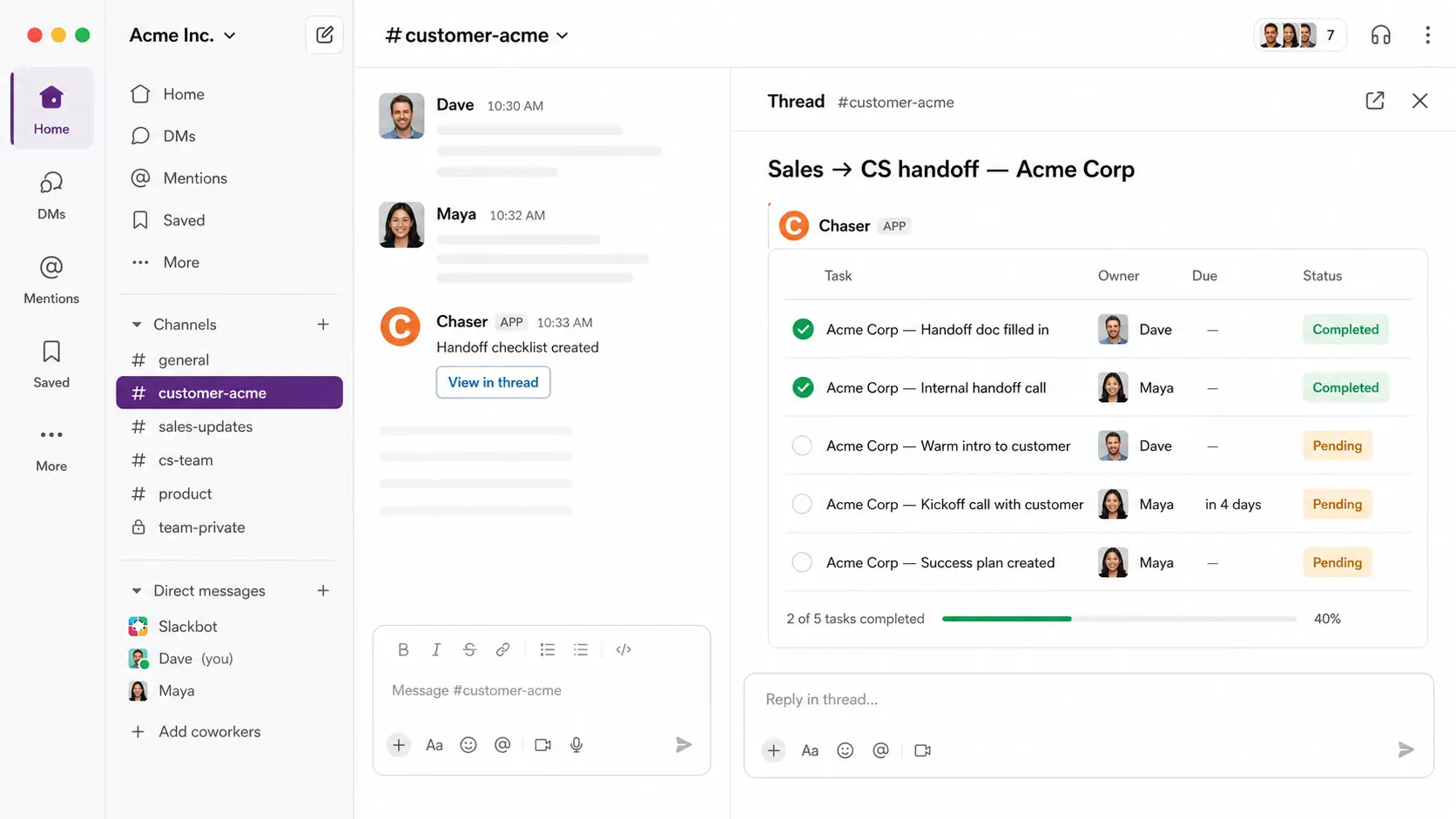
Adjust the steps to your sales motion — a product-led company might replace the warm intro with an in-app transition, an enterprise deal adds a legal and security review — but keep one owner per step and the dates pinned to the close.
The same channel keeps working after the handoff ends, as the home for the ongoing account work; if your customers are agencies-style external partners who share your Slack, this guide to client onboarding in a shared Slack channel covers that variant.
Final thoughts
Treating sales to customer success handoff as a tracked, repeatable checklist is what makes it happen for every deal consistently. Since the steps span teams that share no tool except Slack, that's the sensible place for the checklist to live.
You can try Chaser for free and see how it fits the way your team already works in Slack. Get started and add Chaser to Slack, for free.