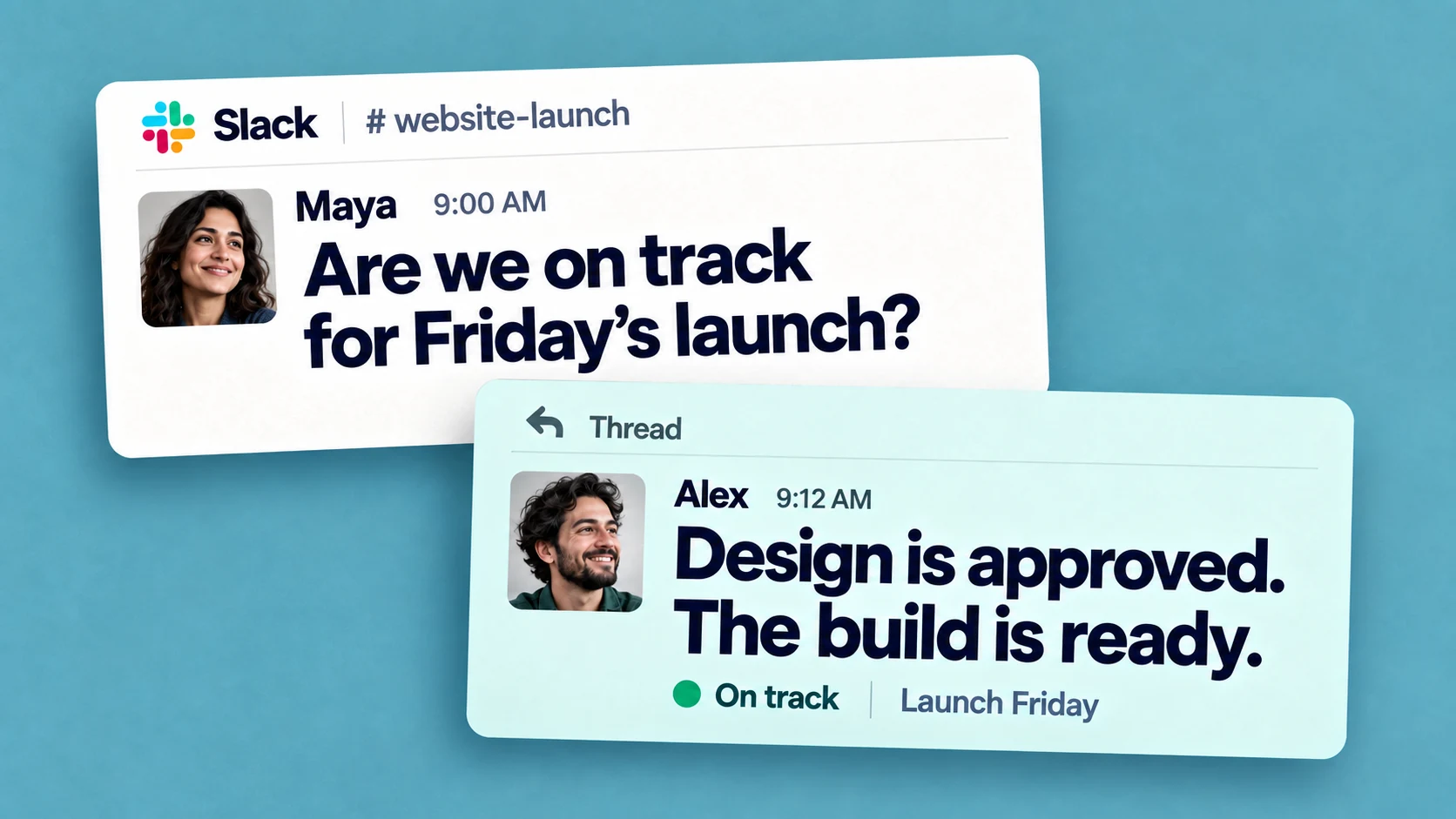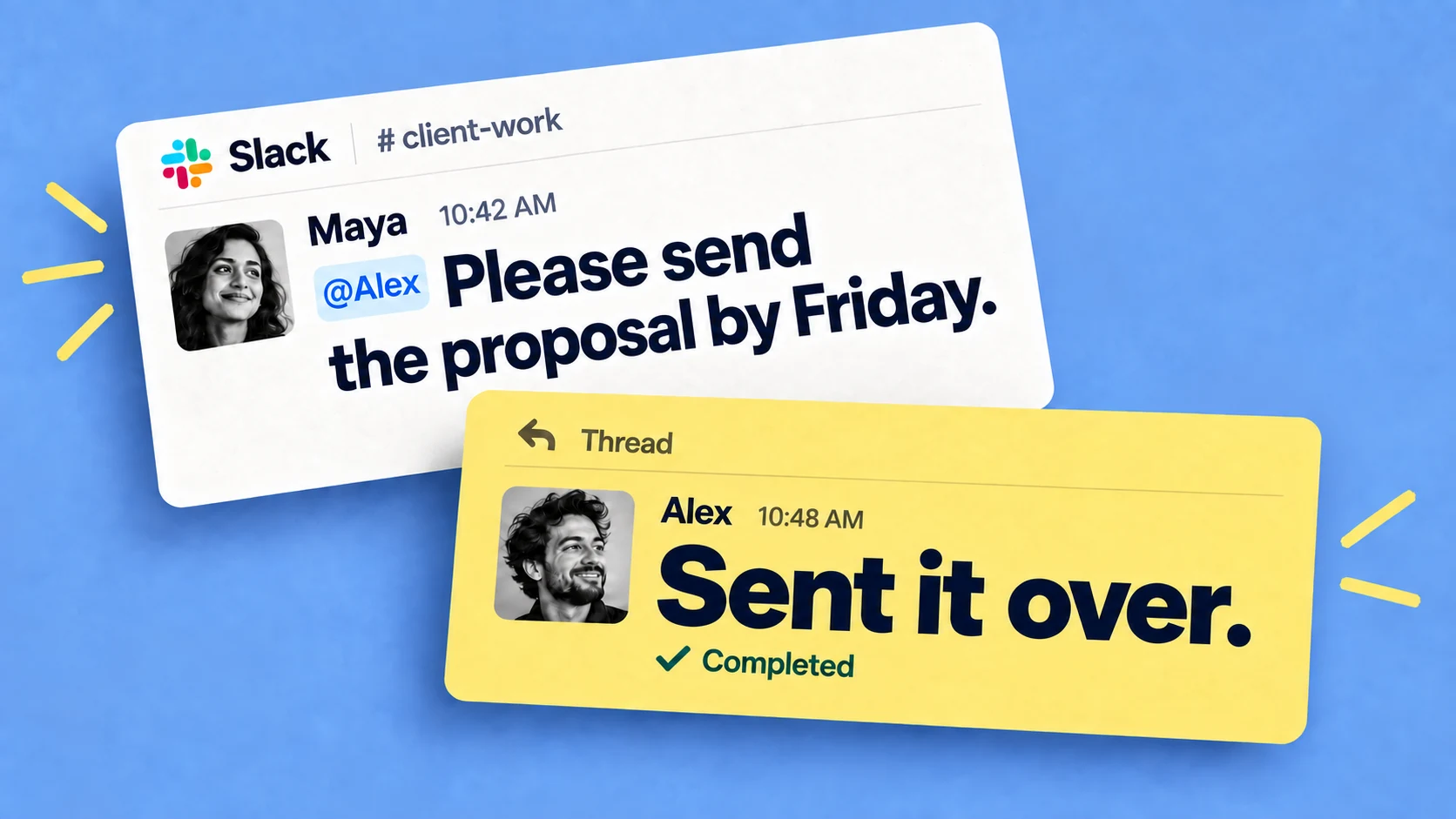

Synchronous communication is what happens in real time: meetings, phone and video calls, Slack huddles or in-person! Examples of asynchronous communication: email, a chat message that can wait, a comment on a doc, a recorded walkthrough.
Most teams use both all day.
Since February 2020, the average Microsoft Teams user's weekly meeting time has grown 252%, and 68% of people say they don't get enough uninterrupted focus time during the workday. Real-time conversation takes every participant's attention at the same moment, which makes it the most expensive way to work a team has.
This post lays out the synchronous vs asynchronous communication trade-off in practical terms.
When synchronous communication is worth it
Some conversations go badly in writing, and for those, real time is best:
- Ambiguity. When the problem itself is unclear — a project kickoff, a decision with many unknowns — ten minutes of live back-and-forth beats forty messages.
- Disagreement and sensitive topics. Tone gets lost in text, and misreadings compound. Feedback, conflict, and personnel conversations belong on a call.
- Brainstorming. Ideas build on each other faster when the loop is seconds, and half-formed thoughts survive better out loud than in a typed message.
- Real emergencies. Production is down, the client is walking — interrupt people.
- Relationships. One-on-ones and team rituals do work that no document can.
The reason to hold the line at this list is what interruptions do to everything else on the calendar. Research on interrupted work from the University of California, Irvine found that people compensate for interruptions by working faster — at the price of more stress, frustration, and time pressure. Harvard Business Review likewise reports that time spent on collaborative activities has grown by 50% or more over two decades, and much of that growth is meetings and pings, the two most interruptive formats there are. This dynamic is covered from the tooling angle in this post on context switching.
When asynchronous communication works better
Most routine coordination doesn't need anyone's immediate attention, and moving it to async gives that attention back:
- Status updates and progress reports. "Where are we on X?" almost never needs a meeting.
- Reviews and approvals. The reviewer needs time with the material anyway; a deadline serves better than a call.
- Announcements and FYIs. Broadcast once, in writing, where people can find it later.
- Anything across time zones. A distributed team's overlap hours are scarce; spending them on readouts wastes the best synchronous time it has.
- Anything that should leave a record. A decision made in a meeting exists only in memory unless someone writes it down. An async decision documents itself.
Async is also the native mode of the newest kind of teammate. AI agents post their work into a thread and wait for a human to respond, which is part of why the current generation of AI project management tools is built on the work chat.
How to make asynchronous communication actually work
Async runs on two things: messages that carry everything the reader needs, and requests that come back on their own if they're ignored. A few habits cover both.
Write complete messages. Context, the ask, and the deadline in one message — never a bare "got a sec?" that forces a synchronous round trip just to learn the topic. If the reader can act without asking a clarifying question, the message did its job.
Put a real date on requests. "ASAP" means nothing across ten open threads. "By Thursday EOD" lets the other person plan their own time, which is the entire point of async.
Default to public channels. An answer given in a DM helps one person once. The same answer in a channel is searchable by everyone who hits the question later.
Track requests that matter. A chat message scrolls away, and finding who promised what later means rereading the channel. If the ask has a deadline and a consequence, give it an owner and a follow-up. In Slack, Chaser handles this without leaving the conversation: turn the message into a task, and Chaser reminds the assignee automatically as the due date approaches.
Record decisions where people will look. When a live conversation does happen, close the loop by posting the outcome back into the channel or the task, so the decision stays findable even though the conversation happened live.

The teams that get this right pick async as the default and treat synchronous time as a deliberate exception, booked when a conversation meets the bar in the list above. A useful escalation rule: when a thread has gone three rounds without converging, move it to a huddle or a call — and post the conclusion back to the thread when you're done.
That default protects focus without making the team slower. Requests arrive with deadlines, work is tracked and chased without anyone hovering, and the calendar holds the small number of conversations that deserve real time.